

























Key Takeaways:
- Wind resistance engineering for high rise construction utilizes aerodynamic shaping such as tapering and setbacks to disrupt vortex shedding and prevent dangerous resonant oscillations that can compromise structural integrity.
- The integration of passive and active damping systems, like Tuned Mass Dampers, acts as a shock absorber for the building, significantly reducing sway and ensuring occupant comfort during high-wind events.
- Extensive wind tunnel testing and Computational Fluid Dynamics (CFD) are essential precursors to construction, providing the empirical data needed to optimize structural resilience and ensure street-level pedestrian comfort.
Wind Resistance Engineering for High Rise Construction
As our cities reach ever higher into the sky, the challenges facing structural engineers shift from the vertical force of gravity to the horizontal and dynamic forces of the wind. For a skyscraper, the wind is not just a passing breeze; it is a relentless and powerful force that can cause the entire structure to sway, vibrate, and, if not properly managed, fail. The sophisticated wind resistance engineering high rise construction requires today is a blend of fluid dynamics, material science, and innovative structural design. It is the invisible force that keeps our modern cathedrals of glass and steel standing straight and safe, even when subjected to the most intense urban wind corridors and extreme weather events.
The Physics of Wind Loads on Tall Structures
The higher a building rises, the more it is exposed to the higher-velocity winds found at higher altitudes. These winds exert pressure on the windward side of the building and create suction on the leeward side. However, the most dangerous phenomenon is “vortex shedding.” When wind hits a square or rectangular building, it detaches from the corners and creates swirling eddies or vortices. If these vortices alternate from side to side at a frequency that matches the building’s natural frequency of vibration, a condition called resonance can occur. This can lead to dramatic oscillations that are not only structurally damaging but also extremely uncomfortable for the building’s occupants.
Mitigating Vortex Shedding through Aerodynamic Shaping
One of the most effective strategies in wind resistance engineering high rise construction is to “confuse” the wind. Architects and engineers work together to design building shapes that disrupt the formation of organized vortices. This can include tapering the building as it rises, rounding the corners, or adding “setbacks” and “cutouts.” For example, the Burj Khalifa in Dubai uses a tiered, tripod-shaped design that sheds wind differently at every level, preventing the build-up of resonant forces. By breaking up the wind’s path, the structural load is significantly reduced, allowing for a more efficient and safer use of materials.
The Role of Porous Facades and Wind Slots
In some designs, engineers incorporate actual holes or “wind slots” through the building. These slots allow air to pass through the structure, equalizing the pressure between the windward and leeward sides. This technique is particularly effective for very slender buildings where traditional stiffening methods might be too heavy or expensive. These slots, combined with carefully engineered porous facades, are part of the holistic suite of wind resistance engineering high rise construction tools that allow for the creation of iconic, needle-thin towers in dense urban environments.
Damping Systems: The Internal Shock Absorbers
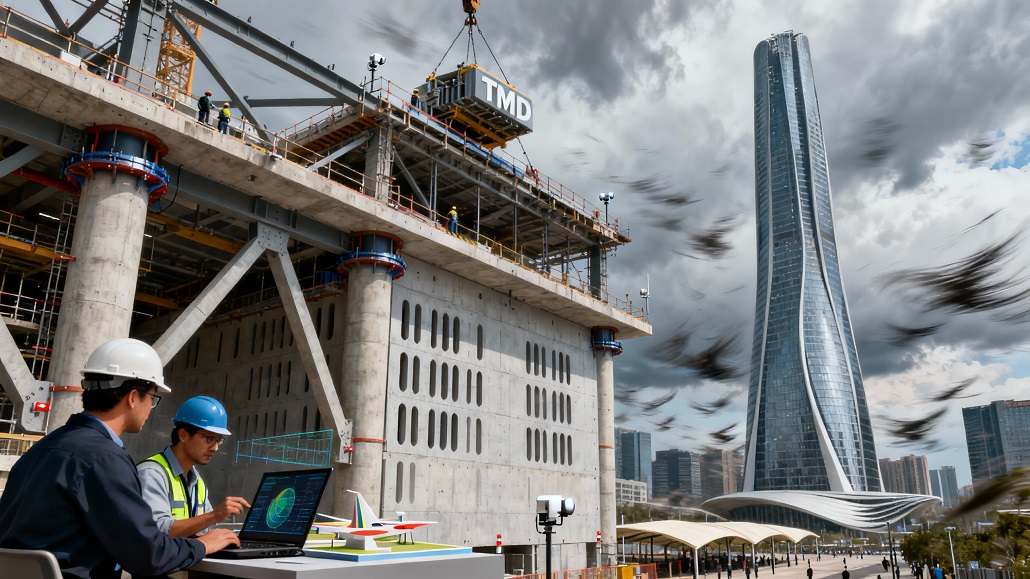
Even with the best aerodynamic shaping, some movement is inevitable. To manage this movement, modern skyscrapers use advanced damping systems. The most common is the Tuned Mass Damper (TMD). A TMD is a massive weight often hundreds of tons suspended near the top of the building. When the wind causes the building to sway in one direction, the weight’s inertia causes it to move in the opposite direction, acting as a counterweight that pulls the building back toward the center. This effectively “dampens” the oscillations, much like the shock absorbers in a car, ensuring that the movement remains well below the threshold of human perception.
Active and Viscous Damping Technologies
Beyond passive mass dampers, some buildings utilize active damping systems where sensors detect movement and computer-controlled actuators move the counterweight with extreme precision. Other towers use viscous dampers essentially giant pistons filled with thick fluid integrated into the structural frame. These devices convert the kinetic energy of the building’s sway into heat, which is then dissipated. The integration of these systems into the wind resistance engineering high rise construction process is what allows for the safe occupation of the upper floors of the world’s tallest buildings during a gale.
The Importance of Wind Tunnel Testing and Computational Fluid Dynamics
Before a single shovel hits the ground, every major high-rise project undergoes extensive testing. Wind tunnel testing involves placing a scale model of the building and its surrounding neighborhood into a specialized tunnel where controlled wind streams are applied. Hundreds of sensors on the model measure the pressure at different points. This physical testing is now supplemented by Computational Fluid Dynamics (CFD), where powerful computers simulate the wind flow around the building in a virtual environment. The data from these tests is critical for the wind resistance engineering high rise construction process, as it allows engineers to fine-tune the structural design for maximum resilience.
Simulating the Urban Environment and Microclimates
High-rise construction doesn’t happen in a vacuum. A new tower will be affected by the buildings around it, and it will, in turn, affect the wind patterns at street level. Wind resistance engineering high rise construction also addresses the “pedestrian wind comfort.” Large buildings can deflect high-altitude winds down to the ground, creating uncomfortably strong gusts for people walking below. Engineers use their simulations to design canopies, landscaping, and building base geometries that mitigate these effects, ensuring that the project enhances rather than degrades the urban environment.
Structural Resilience and Material Innovation
The core of a skyscraper’s strength often lies in its central core or a system of outriggers and mega-columns. High-strength, high-performance concrete (HPC) and advanced structural steel are the primary materials used to provide the necessary rigidity. Innovations in material science, such as fiber-reinforced concrete, provide additional ductility, allowing the structure to absorb energy without cracking. The wind resistance engineering high rise construction depends on these materials to maintain the “stiffness” required to prevent excessive tilting while allowing for the “flexibility” needed to survive extreme gusts without catastrophic failure.
The Future: Smart Materials and Real-Time Monitoring
The next frontier in wind resistance engineering high rise construction involves the use of “smart” materials and structural health monitoring (SHM). Imagine a building where the windows themselves can change their surface texture to disrupt wind flow, or where the structural members are embedded with fiber-optic sensors that provide real-time data on stress and strain. These systems would allow for a “live” response to changing weather conditions, further enhancing the structural resilience of our cities. This data-driven approach will be essential as we continue to push the boundaries of height and architectural form.
Building Safety and International Standards
Compliance with international building codes, such as those set by the Council on Tall Buildings and Urban Habitat (CTBUH) and regional engineering bodies, is non-negotiable. These standards ensure that every skyscraper meets a minimum level of safety and serviceability. The wind resistance engineering high rise construction must account for “100-year events” storms so severe they are statistically likely to occur only once a century. By designing for these extremes, engineers ensure that even during the most severe weather, the building remains a safe haven for its inhabitants.
The Crux of Vertical Engineering
In conclusion, the ability to build upward safely and comfortably is one of the greatest achievements of modern engineering. It is a testament to our understanding of the invisible but powerful forces that shape our world. The wind resistance engineering high rise construction relies on is the vital link between an architect’s ambitious vision and the physical reality of a stable, long-lasting structure. As our urban centers continue to densify and grow taller, the sophistication of these wind engineering techniques will remain the key to creating a resilient and sustainable urban future.
