


























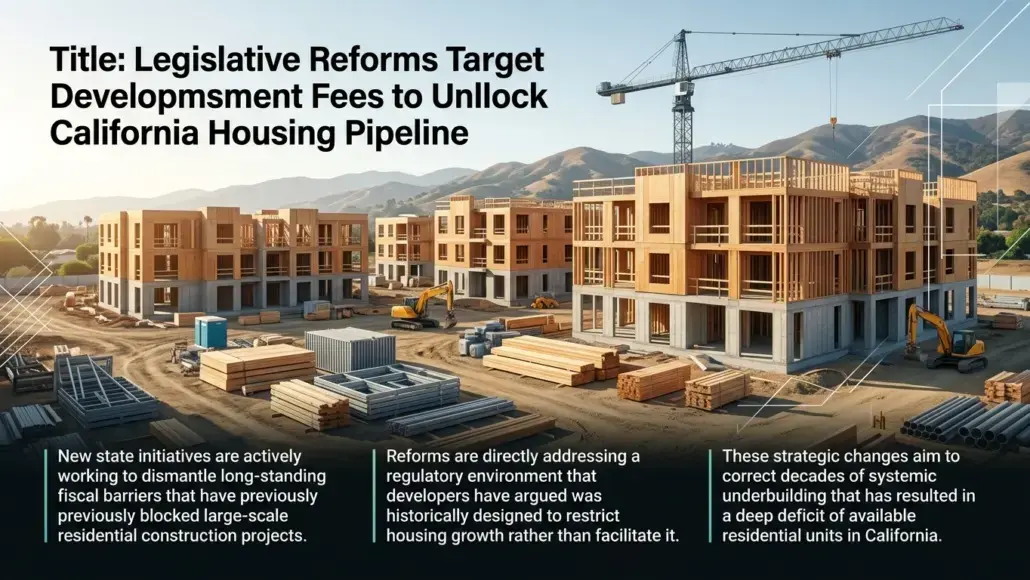


The structural landscape of the residential building sector in California is undergoing a significant shift as state leaders move to dismantle long-standing fiscal barriers that have historically hampered large-scale development. For decades, the construction industry has contended with a regulatory environment that many developers argue was architecturally designed to restrict growth rather than facilitate it. This systemic underbuilding has created a deep deficit in available residential units, particularly in the multi-family and low-income sectors. In a decisive effort to reverse these trends, Governor Gavin Newsom joined local officials in Oakland on Monday to sign Assembly Bill 179 into law. This legislation specifically targets local development impact fees, which have emerged as one of the most significant obstacles to the financial viability of affordable housing construction. By easing these fiscal constraints, the state intends to recalibrate the economic equation of residential development, ensuring that capital is directed toward the actual assembly of units rather than being absorbed by municipal administrative costs.
The Architecture of Restriction: Decades of Underbuilding
The housing shortage currently facing California is a multifaceted crisis that state leaders describe as an intentional outcome of past policy decisions. During the signing ceremony in Oakland, Governor Newsom emphasized that the current hole the state has dug for itself over the last half-century was not an accidental occurrence. Instead, he argued that the systemic lack of supply was a product of deliberate design choices in zoning and land-use regulations. “It was intentionally designed,” Newsom stated. “It wasn’t by chance. It wasn’t by happenstance. It was designed NOT to build.” This historical context provides the foundation for the new legislation, which seeks to overhaul the very mechanisms that have prevented developers from breaking ground on high-density projects.
While previous state efforts have focused on easing zoning and land-use restrictions, the focus of Assembly Bill 179 is purely financial. Local development impact fees—initially created to help municipalities offset the infrastructure effects of new residents—have evolved into a primary barrier. Newsom described some of the existing fee structures in various cities and counties as “comical” and “outrageous,” asserting that they make it “quite literally, impossible to develop an affordable unit.” The state’s strategy now involves using its considerable funding power to force local governments to reconsider these costs, essentially establishing a “no fee” requirement for any municipality seeking state financial assistance for housing initiatives.
The State Funding Contingency and Local Budgetary Concerns
The leverage used by Assembly Bill 179 is direct: access to state coffers is now contingent upon local fee waivers. Governor Newsom was unequivocal about this new relationship between state and local governments. “If you want state funding, you want a dollar, you want $200, you want $200 million…no local impact fees,” he declared. This hard-line approach is designed to ensure that state investments in housing are not diluted by local fee assessments. State Sen. Jesse Arreguín, a co-author of the bill and the former mayor of Berkeley, echoed this sentiment, noting that constituents often express frustration over the lack of visible progress despite high state spending on homelessness and housing. Arreguín argued that addressing impact fees is essential to “maximizing the state’s investment in funding to get homes built now.”
However, this policy shift presents a challenge for cities and counties that have grown reliant on impact-fee revenue to fund essential services such as parks and street maintenance. Critics of the measure point to a potential “budget hole” created by the loss of these funds. In response, advocacy groups like Generation Housing suggest that this concern ignores the opportunity cost of housing that is never built. Stephanie Picard Bowen, the group’s deputy director, pointed out that municipalities can only collect fees on projects that actually move forward. “Right now, they can only charge on projects when they happen,” she noted. “So, in a market when projects aren’t penciling and we’re not getting any housing, they’re not collecting fees anyway.”
A Strategic Choice Between Fees and Housing
The central argument in favor of the bill is that the presence of some housing with no fees is infinitely better than no housing and no fees. Picard Bowen summarized the dilemma by stating, “If the option is no fees but some housing, and no fees and no housing, I think I know which is the better option.” This perspective underscores the reality that excessive fees have driven the cost of building so high that many projects never reach the stage where fees would even be collected. By removing the fee barrier, the state hopes to reach a tipping point where developers can once again find the necessary margins to justify new projects, thereby increasing the overall supply of residential units.
While Assembly Bill 179 is a major step in the state’s housing strategy, officials recognize that it is not a singular solution to the crisis. Various market forces beyond the control of state legislation continue to influence the rate of new construction. Nevertheless, by capping impact fees, the administration is attempting to stop the fiscal practices that have contributed to the current supply deficit. As Newsom suggested during the signing, the first step to correcting a massive underbuilding problem is to stop the policies that created it. The new law represents a significant effort to streamline the process of affordable housing construction and ensure that local administrative costs do not stand in the way of state-wide residential growth.