






























Most construction schedules fall apart not because the plan was bad, but because nobody could see the cracks forming in real time. Construction Project Scheduling Tools exist to fix exactly that, yet choosing the wrong one means your super is still getting schedule updates via text message while the project bleeds float. After reviewing dozens of platforms against real field conditions, including how they handle RFI disruptions, subcontractor coordination, and last-minute weather delays, this guide breaks down the five best options worth your time.
The research approach for this ranking started with gathering publicly available information across review platforms, vendor case studies, feature documentation, and official product pages. Only platforms with a verifiable track record in construction environments made the cut, because general project tools don’t always hold up against the demands of multi-trade scheduling.
See the full research breakdown
- Planera – Best for construction project scheduling and CPM planning
- monday.com – Best for team collaboration and customizable project management
- Procore – Best for construction management platforms for enterprises
- Autodesk Construction Cloud – Best for general contractors, specialty contractors, and construction owners
- Wrike – Best for enterprise project and workflow management
Why Construction Project Scheduling Tools Matter for Your Business
Picking the right scheduling tool isn’t just a software decision. It’s a decision about whether your project finishes on time or bleeds margin on every delay.
Managing schedule dependencies across multiple subcontractors and trade crews at the same time is genuinely hard. One RFI response that runs a week late can cascade into three missed deadlines before anyone notices. Real-time schedule visibility closes that gap before it becomes a claim.
The tools that actually move the needle are the ones that keep your Schedule Performance Index honest, help you track Planned Value against what’s actually been earned, and give your field teams weekly Percent Plan Complete data they can act on. That kind of alignment between office and field is rare. But the right tool makes it standard.
Top 5 Construction Project Scheduling Tools Breakdown and Comparison
Note: All data in this table is sourced from review platforms and the official websites of the listed companies.
| Company Name | Years Operating | Team Size |
|---|---|---|
| Planera | Est. 2021 | 49 |
| monday.com | Est. 2012 | 2,508 |
| Procore | Est. 2002 | 4,421 |
| Autodesk Construction Cloud | Est. 2019 | Not disclosed |
| Wrike | Est. 2006 | 1,000+ |
1. Planera – Best for Construction Project Scheduling and CPM Planning
What Does Planera Do?
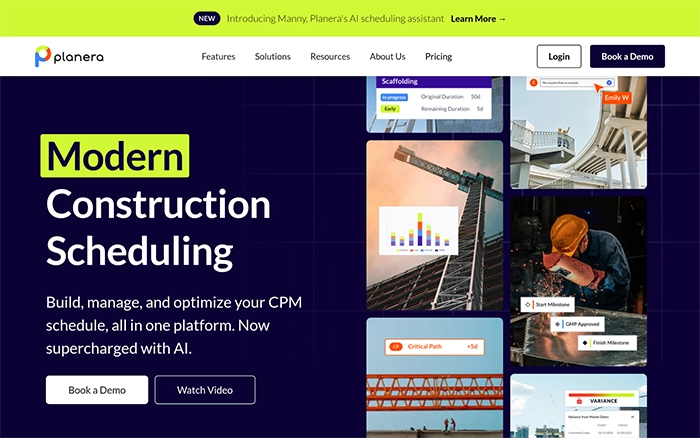
Planera is a collaborative online whiteboard designed to create and manage CPM schedules in construction. The platform lets contractors build resources and cost-loaded schedules quickly, without needing a dedicated scheduling expert on staff. It connects office and field teams through a single source of truth, and it integrates with Procore, Autodesk, Primavera P6, and Microsoft Project. For teams managing multiple live projects, that kind of real-time shared visibility tends to matter a lot.
Why Planera Stands Out for Construction Project Scheduling Tools:
Planera directly tackles one of the most persistent problems in construction scheduling: the gap between complex CPM tools and the people who use them every day. Their whiteboard-first approach means project teams can build and update schedules without the steep learning curve that typically comes with enterprise scheduling software.
Summary of Real User Reviews:
From what the data shows, Planera has built genuine trust with firms like Granite, Barton Malow, and Blach Construction across more than 500 live projects. The $26.9M in funding, backed by industry operators like Zachry Construction, signals that experienced contractors believe this platform solves a real problem (not just a software one). That kind of industry-insider backing is honestly hard to fake.
2. monday.com – Best for Team Collaboration and Customizable Project Management
What Does monday.com Do?
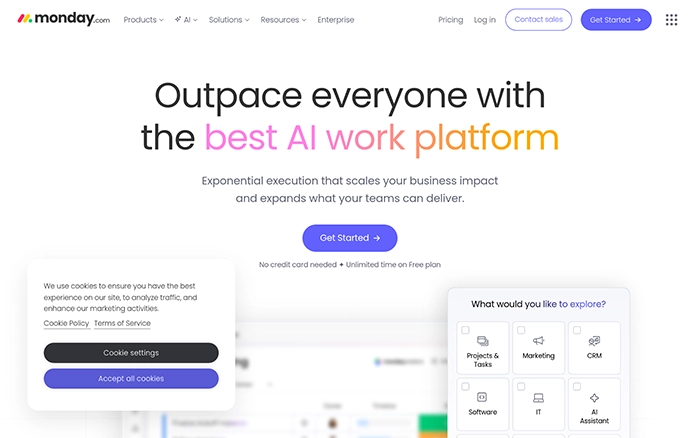
monday.com is a work operating system used by over 152,000 customers across more than 200 countries. The platform is built around modular building blocks, which means teams can configure it to fit their specific workflows rather than adapting their process to fit the software. It covers project and portfolio management, resource tracking, digital whiteboarding, and custom reporting. For construction teams that need flexible coordination across multiple concurrent projects, the configurability is genuinely useful.
Why monday.com Stands Out for Construction Project Scheduling Tools:
monday.com gives construction teams a highly adaptable workspace that can mirror the specific way a general contractor or owner’s rep manages their project phases and trade coordination. That flexibility, backed by four consecutive years as a Gartner Magic Quadrant Leader for Adaptive Project Management, shows this isn’t just a general tool that construction teams are repurposing by accident.
Summary of Real User Reviews:
Customers consistently point to the platform’s ease of setup and the speed at which teams get productive (which matters when you’re starting a new project mid-cycle). Reported productivity gains of up to 50% from enterprise clients like Indosuez suggest the workflow automation features deliver real results. Honestly, for teams that need coordination more than deep CPM scheduling, monday.com is worth a close look.
3. Procore – Best for Enterprise Construction Management
What Does Procore Do?
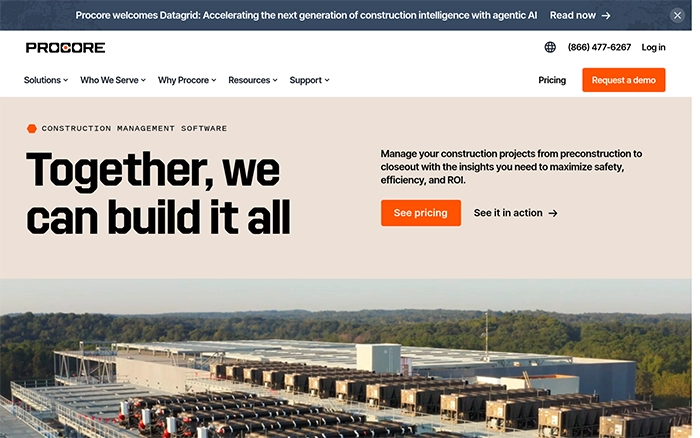
Procore is a purpose-built construction management platform covering every phase of a project, from preconstruction through closeout. It serves owners, general contractors, and specialty contractors with tools for project management, financial management, workforce management, and analytics. The platform runs on an unlimited user model, which removes the seat-licensing friction that typically frustrates large multi-party project teams. Procore Helix adds AI-driven automation for document summarization and process tasks, which can meaningfully reduce admin load on busy project managers.
Why Procore Stands Out for Construction Project Scheduling Tools:
The challenge most enterprise construction teams hit isn’t a lack of data but the inability to connect schedule, cost, and field activity in one place. Procore’s unified platform addresses that by keeping every team member, from the PM in the office to the superintendent on site, working from the same connected data set.
Summary of Real User Reviews:
SelectHub analysts gave Procore best-in-class marks across mobile capabilities, construction financials, safety management, and bidding, which lines up with what users tend to praise in reviews. The 2-million-plus user count across 150 countries suggests this platform scales well across different project types and team sizes. Teams that fully commit to the platform tend to see the biggest gains, but there is a learning curve upfront (think enterprise-level depth).
4. Autodesk Construction Cloud – Best for End-to-End Project Delivery
What Does Autodesk Construction Cloud Do?
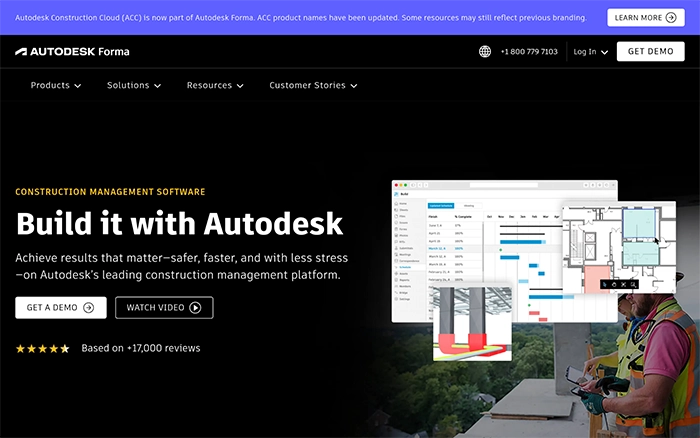
Autodesk Construction Cloud, now part of Autodesk Forma, connects the full project lifecycle from design and preconstruction through building and operations. The platform serves general contractors, specialty contractors, and owners with tools for BIM, cost management, safety tracking, and project coordination. What separates it from general project platforms is the design-to-field continuity: teams can catch clashes during design, track quantities accurately, and keep field progress tied directly to the model. The BuildingConnected network brings nearly one million subcontractors into the same ecosystem.
Why Autodesk Construction Cloud Stands Out for Construction Project Scheduling Tools:
No other platform in this category connects design-phase decisions to field-phase scheduling at this scale, and that matters when late design changes are still burning float on your schedule. Brinkman Construction is completing tasks twice as fast, and CCPI is delivering 97.8% of projects on time and within budget; these are the kinds of numbers that reflect a real operational shift, not just better software.
Summary of Real User Reviews:
The 2023 Technology Solution Award from The Inside Construction Foundation Awards reflects recognition from within the industry, not just general software circles (which tends to be more meaningful). Clients like John Holland Group and Aurecon have publicly documented performance improvements, lending weight to the platform’s claims. And the value really does compound the more a team’s workflow becomes integrated around it.
5. Wrike – Best for Enterprise Project and Workflow Management
What Does Wrike Do?
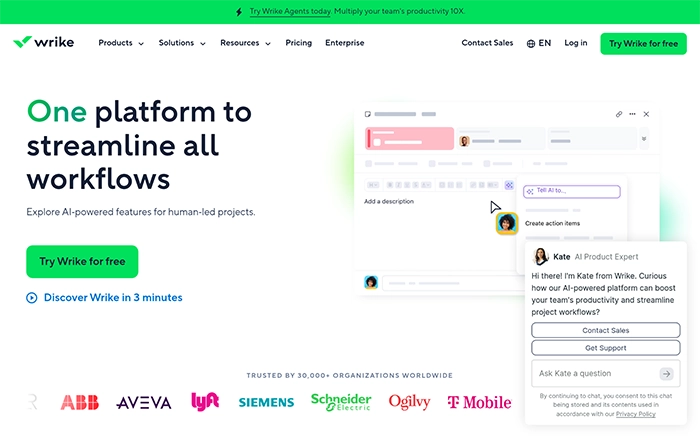
Wrike is a project management and collaboration platform serving more than 20,000 companies worldwide. The platform handles involved workflows through interactive Gantt charts, resource management views, dependency tracking, and time management. It integrates with 400-plus applications and runs across 10 global hubs. For construction teams managing multiple concurrent workstreams, Wrike’s workload visibility and deadline tracking features provide a structured way to keep everyone coordinated without drowning in email threads.
Why Wrike Stands Out for Construction Project Scheduling Tools:
Construction teams managing large-scale programs with multiple workstreams, subcontractors, and overlapping deadlines need more than a simple task list. Wrike’s Gantt chart depth, combined with predictive recommendations through Wrike AI, gives project managers a practical way to spot schedule risks before they hit the schedule’s longest path.
Summary of Real User Reviews:
Wrike earned a 2024 Top Rated award from TrustRadius across 14 categories, and clients like Siemens and Estee Lauder have reported 50% productivity increases alongside a 90% reduction in email volume. Users value the configurability but note that getting the most out of Wrike requires some setup investment upfront. That kind of depth is impressive, though it does mean teams should budget time for getting up to speed (not cheap on the clock, but worth it long-term).
Research Methodology and Selection Process
Initial Data Collection
Building the longlist started by pulling company profiles from construction software directories, general project management review platforms, and industry-specific databases. Official product pages were cross-referenced with third-party listings to build a picture of what each platform actually does versus what its marketing says it does. The focus throughout was on platforms with documented activity in construction environments, not just general project management categories.
Shortlisting Phase
After the initial pool was assembled, platforms without verifiable construction-specific use cases were removed from consideration. Review patterns were analyzed across multiple sources to identify consistency. Platforms showing only a handful of reviews, or reviews concentrated suspiciously in a short time window, were flagged and deprioritized. The goal was to surface tools with a sustained track record, not just recent marketing momentum.
Verification of Claims
Each platform’s stated capabilities were tested against what real users reported in documented reviews and case studies. Where a vendor claimed real-time collaboration or CPM scheduling support, that claim was checked against published customer outcomes and third-party analyst assessments. Any platform where the marketing claims outpaced the evidence was weighted down in the evaluation.
Authority and Industry Contribution Layer
Platforms were also assessed for their standing within the construction industry beyond their own marketing channels. This included analyst recognition from sources like Gartner, awards from construction-focused organizations like The Inside Construction Foundation, and funding history from industry operators. A platform backed by active contractors and recognized by industry analysts carries more weight than one with general software accolades alone.
Construction Project Scheduling Tools-Specific Evidence
The final filter was the most focused: each platform needed documented evidence of construction scheduling use. That meant looking for dedicated scheduling feature pages, verified reviews from project managers and superintendents, and case studies tied to real construction outcomes. Metrics like on-time project delivery rates, subcontractor coordination improvements, and schedule performance data were prioritized over general productivity claims. Platforms with this kind of construction-specific evidence earned their place in the final list.
How to Choose the Right Construction Project Scheduling Tools
Choosing the right platform comes down to matching the tool’s depth to the actual demands of your projects. A small residential contractor and a large commercial GC have very different needs, so here’s what to look at before committing.
- Industry and Domain Experience: Look for platforms with documented use in construction, not just general project management. Tools built for software teams or marketing departments rarely handle CPM logic, float tracking, or subcontractor layering without workarounds.
- Features and Service Offerings: Prioritize real-time schedule updates, resource and cost loading, and field-to-office sync. If you can’t update a deadline from the site and have it reflect immediately in the office, you’re still managing blind.
- Pricing Structure: Seat-based pricing can get expensive fast on multi-party projects. Platforms with unlimited user models or project-based pricing tend to work better for construction teams with many participants.
- Results Measurement: Ask vendors how they track Schedule Performance Index and Percent Plan Complete. If they can’t speak to those metrics, the tool probably wasn’t built with construction delivery in mind.
- Industry Knowledge and Compliance: Check that the platform supports AIA contract standards, OSHA regulations, and local building code workflows. Tools that don’t account for these requirements create compliance gaps that cost real money.
Bottom Line
The right construction project scheduling tool closes the gap between what the schedule says and what’s actually happening in the field. Planera leads for CPM-specific construction work, Procore and Autodesk suit enterprise and full-lifecycle teams, monday.com fits flexible coordination needs, and Wrike handles involved multi-workstream programs. As real-time collaboration becomes the standard expectation across the industry, the platforms that keep field and office genuinely connected will only grow more important.