





















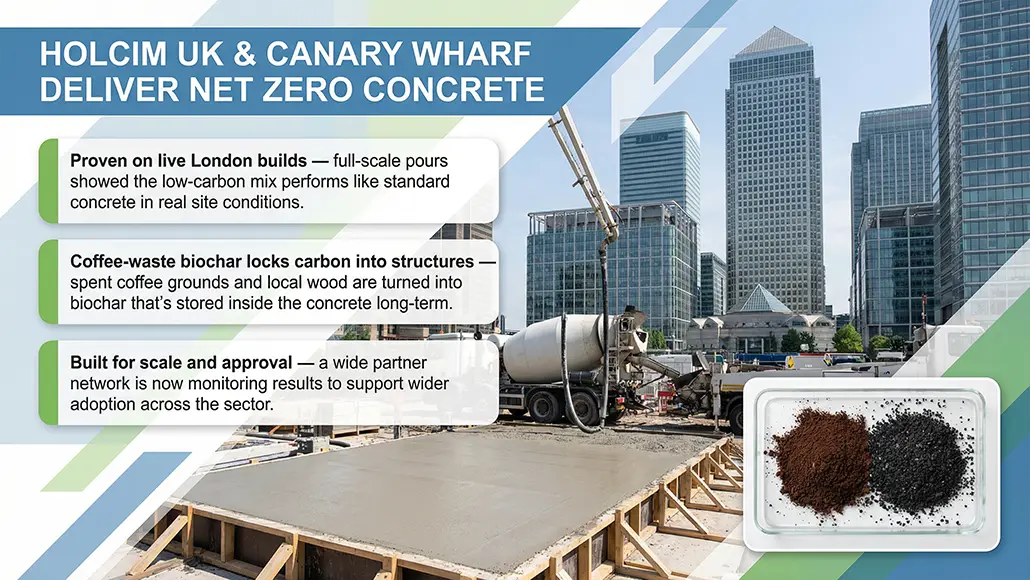


Holcim UK and Canary Wharf Group have reported the successful delivery of net zero concrete, following a six-month research and development programme carried out across active construction sites in London. The initiative, described as an industry first, validated the performance of ultra low-carbon concrete mixes through full-scale trials at Canary Wharf. By combining fossil emissions with biogenic carbon storage, the project achieved a projected footprint of -14 kgCO₂e/m³, positioning net zero concrete as a viable solution for one of the most emissions-intensive sectors globally. Concrete production is estimated to contribute 7 to 8 percent of global CO₂ emissions, placing it under increasing regulatory and investor scrutiny.
The programme brought together a wide network of partners, including O’Halloran O’Brien, Arup, Ramboll, B&GE, Thornton Tomasetti, Walsh Associates, and Robert Bird Group, alongside academic contributors from Queen’s University Belfast and the University of Cambridge. Their collective objective centred on proving that next-generation materials could meet or exceed the performance of traditional concrete while significantly lowering emissions. Trials were conducted across multiple live construction environments, reinforcing confidence in scalability and real-world application.
A key component of the innovation lies in the use of biochar derived from waste coffee grounds and wood sourced within Canary Wharf. This circular approach enabled emissions reductions of up to 80 percent compared to conventional CEM I concrete, initially achieving 69 kgCO₂e/m³ before further optimisation pushed the mix into negative emissions territory. The process captures carbon absorbed during plant growth and permanently embeds it within the concrete matrix, effectively transforming built structures into long-term carbon storage systems.
Jasen Gauld, National Readymix Product Development Director for Holcim UK, said: The aim of these trials was to show that next-generation concrete mixes can perform as well as, or better than, standard concretes giving contractors and the wider supply chain confidence to adopt them and embedding circular thinking into the buildings we help create. By optimising the biochar-coffee mix, we have achieved net zero concrete a Holcim first while maintaining strength, durability, and circularity. Where increased binder might otherwise have been needed, our products can remove that requirement, reducing overall embodied carbon. At the same time, the carbon in the biochar is locked into the concrete, allowing buildings to fulfill a new role as long-term carbon stores, keeping CO₂ safely out of the atmosphere. This demonstrates that high-performance, low-carbon, circular materials are ready for real-world use.
Unlike controlled laboratory demonstrations, the materials were deployed in live construction scenarios, including a full-scale slab beneath a theatre at Wood Wharf and deep raft slabs at Bank Street. Earlier applications extended to underwater counterweights for the Whale on the Wharf installation. Additional trials explored graphene-enhanced mixes and ECOCEM ACT blends, both contributing further emissions reductions while improving material performance. All solutions will now undergo two years of monitoring by project partners, including Skanska, Arup, and Queen’s University Belfast, to generate verified data supporting regulatory approval and broader adoption.
Jonathan Ly, Director of Structures at CWG, said: This collaboration represents a pivotal moment for the real estate sector’s transition to net zero. As both developer and main contractor, CWG occupies a unique position in the industry where we can validate next-generation materials on live projects at pace, allowing us to build the market confidence that low-carbon concrete needs to become mainstream. Achieving net-zero concrete with our biochar-coffee mix demonstrates that circular economy principles aren’t just aspirational, they can deliver measurable environmental and commercial value. By transforming spent coffee grounds from our own retailers into a construction material that sequesters carbon, we’re proving that sustainable development can be both ambitious and practical.