


























Key Takeaways:
- Safety standards for large scale construction have evolved from reactive regulations into proactive, technology-driven management systems that integrate hazard identification into the earliest design phases of a project.
- Cultivating a “zero-harm” culture where every worker feels empowered to prioritize safety is essential for the successful implementation of high-level standards on complex, multi-subcontractor job sites.
- Investing in advanced safety practices is a strategic financial decision that significantly reduces project delays, insurance costs, and legal liabilities while enhancing a company’s reputation and ESG performance.
Safety Standards Advancing Large Scale Construction Projects
In the high-stakes arena of large-scale infrastructure and commercial development, the complexity of the work is matched only by the magnitude of the risks involved. From massive skyscrapers to sprawling transportation networks, these projects involve thousands of workers, heavy machinery, and high-risk activities performed around the clock. In this environment, the rigorous safety standards large scale construction requires are not just a set of rules; they are the fundamental architecture of modern project management. By prioritizing human life and structural integrity above all else, these standards have transformed the industry from one defined by danger to one characterized by precision, accountability, and a “zero-harm” culture.
The Evolution of Construction Safety Regulations
Historically, construction was often viewed as a “necessarily dangerous” profession. However, the introduction of comprehensive national and international building regulations such as those from OSHA in the United States or the Health and Safety Executive (HSE) in the UK has fundamentally changed that perception. The safety standards large scale construction projects now operate under are based on the principle that every accident is preventable. These regulations have evolved from simple reactive checklists to sophisticated proactive systems that demand a deep understanding of hazard identification and risk assessment before a single worker sets foot on the site.
The Role of Integrated Safety Management Systems (ISMS)
Modern large-scale projects utilize Integrated Safety Management Systems (ISMS) to embed safety into every phase of the project lifecycle. This begins during the design phase, where “Safety by Design” principles are used to identify and eliminate hazards before they even reach the job site. For instance, designing permanent anchors for fall protection or specifying materials that do not require hazardous cutting processes on-site. The safety standards large scale construction projects follow ensure that safety is treated with the same level of importance as budget and schedule, creating a holistic framework where compliance is the baseline, not the goal.
Digital Transformation and Real-Time Risk Management
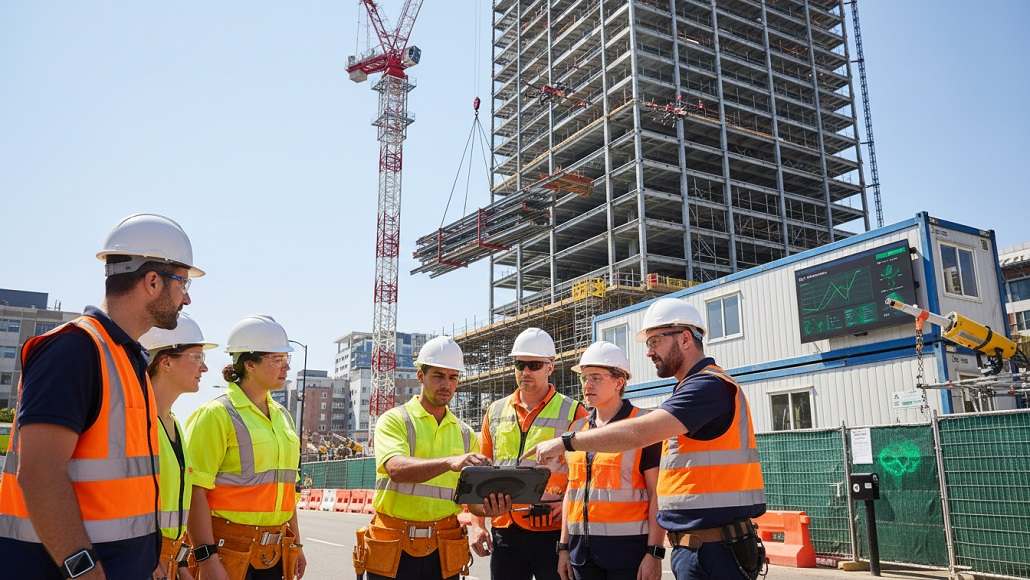
Technology is playing an increasingly critical role in advancing safety. On many large job sites, workers now wear “smart PPE” equipped with sensors that can detect falls, monitor vital signs, or alert them if they enter a high-risk “no-go” zone. Drones are used to conduct high-risk inspections of cranes and scaffolds, removing the need for human exposure to heights. Furthermore, Building Information Modeling (BIM) allows safety managers to virtually “walk through” the project at different stages of construction to identify potential safety bottlenecks. This digital integration of safety standards large scale construction depends on provides a level of oversight that was previously impossible.
Cultivating a “Zero-Harm” Culture
While technology and regulations are essential, the true effectiveness of safety standards large scale construction projects depends on the culture on the ground. A “zero-harm” culture is one where every person on the site from the CEO to the newest apprentice feels responsible for their own safety and the safety of their colleagues. This is achieved through continuous training, daily “toolbox talks,” and an environment where workers are encouraged to “stop work” if they identify an unsafe condition without fear of reprisal. This psychological safety is the foundation upon which all other safety standards are built.
The Impact of Training and Competency Verification
In a large-scale project, the diversity of the workforce can be a challenge. Workers from dozens of different subcontractors, often speaking multiple languages, must all adhere to the same safety standards large scale construction demands. This requires standardized, high-quality training and rigorous competency verification. Many projects now use digital “safety passports” that track a worker’s training record and certifications. Before being allowed to operate a specific piece of machinery or perform a high-risk task, the worker must prove they have the necessary skills and knowledge. This commitment to competency is a key driver in reducing incidents and improving overall project compliance.
Addressing High-Risk Activities with Precision
The “Fatal Four” falls, being struck by objects, electrocutions, and caught-in-between hazards remain the primary focus of safety standards large scale construction. To combat these, projects implement highly specific protocols. Fall protection systems have evolved from simple harnesses to advanced “leading edge” equipment that can arrest a fall without injuring the worker. Lifting operations involving giant tower cranes are planned with millimeter precision using specialized software that accounts for wind speeds, ground conditions, and the “swing radius” of the load. This level of technical precision is what allows these massive projects to proceed safely in dense urban environments.
Infrastructure Projects and Public Safety
When a construction project takes place in a public area such as a bridge renovation or a new subway line safety standards large scale construction must also protect the community. This involves sophisticated traffic management plans, noise and dust mitigation strategies, and robust perimeter security. The goal is to minimize the “footprint” of the construction risk on the surrounding neighborhood. Public safety is an integral part of the project’s reputation and legal standing, and modern standards ensure that the construction activity does not compromise the well-being of the people it is ultimately designed to serve.
The Financial Case for Superior Safety Performance
There is a common misconception that high safety standards increase costs. In reality, the opposite is true. An accident on a large-scale project can lead to massive delays, legal fees, increased insurance premiums, and irreparable damage to a company’s reputation. Conversely, projects with excellent safety records often see higher productivity, lower turnover, and smoother regulatory approvals. The safety standards large scale construction projects implement are a form of financial risk management. By investing in safety today, developers and contractors protect the long-term profitability and viability of their projects.
International Compliance and ESG Reporting
In the global construction market, safety performance is a key metric for Environmental, Social, and Governance (ESG) reporting. Investors and institutional lenders are increasingly looking for projects that can demonstrate a high level of social responsibility. Adherence to the highest safety standards large scale construction can offer is a powerful signal of a well-managed and sustainable project. This global alignment of safety and financial performance is driving the industry toward even higher levels of transparency and accountability.
Future Horizons: AI and Autonomous Safety Systems
Looking to the future, the industry is exploring the use of Artificial Intelligence (AI) to predict and prevent accidents. AI algorithms can analyze site data, weather patterns, and historical incident records to alert managers to high-risk days or locations. We are also seeing the rise of autonomous and semi-autonomous machinery, which removes workers from the “line of fire” in dangerous tasks like tunneling or heavy earthmoving. These advancements will continue to evolve the safety standards large scale construction relies on, pushing the industry closer to the ultimate goal of zero injuries on every job site.
The Crux of Construction Excellence
In conclusion, the advancement of our built environment is inextricably linked to the advancement of our safety practices. The sophisticated safety standards large scale construction projects utilize are the result of a collective commitment to excellence and a profound respect for human life. As we take on ever-larger and more complex challenges, from sustainable “smart cities” to massive renewable energy infrastructure, the core of our success the safety standards large scale construction will remain the most essential foundation for every project we build.