

























Key Takeaways
- Proactive interaction between robots and workers can boost construction productivity by up to 22%
- Cobots equipped with sensor technology can detect worker cognitive load and adjust operational pace accordingly
- Human-machine collaboration maintains worker autonomy while reducing exposure to hazardous conditions
- Integrated teams leverage human judgment for complex tasks while robots handle repetitive, physically demanding work
- Effective task allocation between humans and machines requires clear workflow design and worker training
Redefining Construction Teamwork Through Human-Machine Integration
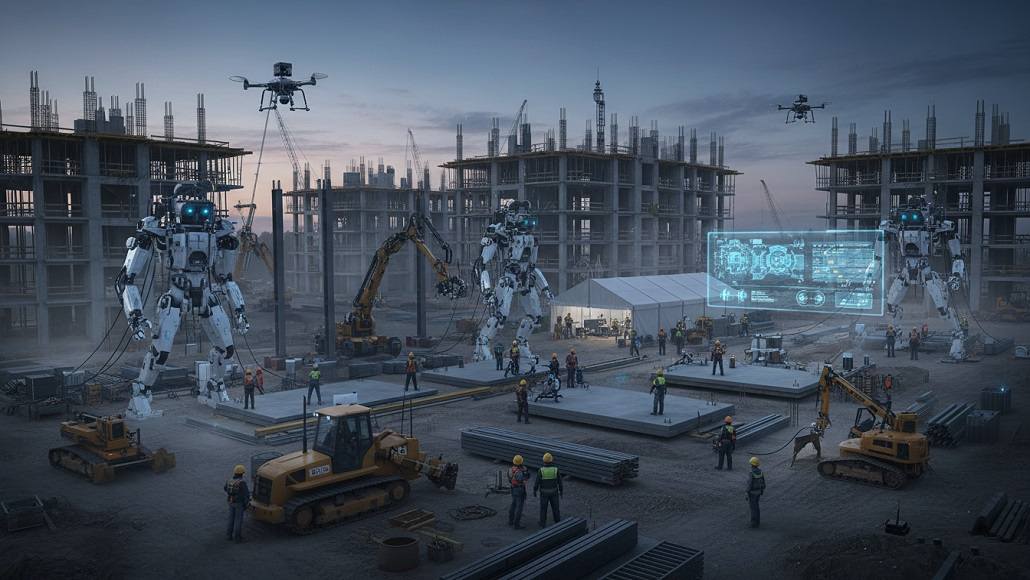
Construction sites have traditionally relied exclusively on human labor performing physical work while supervisors managed operations and coordinated activities. This operational model persists despite well-documented challenges including occupational injuries, labor shortages, repetitive strain conditions, and the profound physical demands of construction work. However, emerging collaborative robotics and advanced automation technologies now enable fundamentally different operational models where human-machine collaboration construction establishes integrated teams combining human judgment and skill with mechanical precision and tireless execution capacity.
The transition toward collaborative construction models represents significant philosophical shift beyond simple automation. Rather than replacing human workers or reducing them to equipment operators, sophisticated collaborative systems position humans and machines as interdependent team members, each contributing distinct capabilities that strengthen overall performance. Workers maintain supervisory roles, complex decision-making responsibilities, and strategic task allocation while robots execute repetitive, physically demanding, or hazardous activities. This complementary relationship creates working environments where human expertise guides machine operations while mechanical systems protect workers from injury risk and physical exhaustion.
Understanding Collaborative Robot Capabilities and Integration
Collaborative robots, increasingly referred to as cobots, incorporate advanced sensing, artificial intelligence, and intuitive human-machine interfaces enabling safe operation alongside workers in shared jobsite environments. Unlike traditional industrial robots confined to dedicated caged areas, cobots function effectively in unstructured construction environments where conditions change continuously and unexpected obstacles require adaptive response. Advanced sensor systems enable cobots to detect worker proximity, recognize hazardous approaches, and modify operational behavior ensuring worker safety without compromising task execution efficiency.
Construction applications for cobots span diverse activities from material handling and assembly tasks to specialized operations like bricklaying, welding, and structural element positioning. Cobots can reliably lift and transport heavy materials, reducing physical strain on workers while accelerating material flow to work areas. In high-rise construction, where elevating materials to work locations represents a persistent operational bottleneck, autonomous or teleoperated robotic material handlers significantly expand crane utilization efficiency while reducing worker exposure to height-related hazards. Material delivery robots navigate complex site environments autonomously, delivering specific items to designated work areas with precision scheduling optimization that traditional human-dependent delivery systems struggle to achieve.
The fundamental advantage of collaborative robots emerges through task allocation strategies that position humans and machines as complementary specialists rather than competitors. Workers perform complex tasks requiring spatial reasoning, problem-solving, and adaptive response to unexpected conditions. Robots execute repetitive operations, maintain consistent performance across extended durations, and work in hazardous environments where prolonged human exposure poses unacceptable risk. This division of labor, carefully designed through collaborative workflow analysis, creates operational efficiency exceeding what either humans or machines achieve independently while fundamentally transforming jobsite safety profiles.
Advanced Workforce Monitoring and Cognitive Load Integration
Recent research into human-machine collaboration construction reveals that effective teamwork requires more sophisticated understanding than simply allocating tasks between human and robotic workers. Workers operating in construction environments experience cognitive load mental effort devoted to processing information, making decisions, and managing multiple simultaneous concerns. When cognitive load exceeds optimal thresholds, worker performance deteriorates, error rates increase, and safety risks substantially escalate. Traditional construction management approaches provided limited visibility into worker cognitive status, responding to performance problems only after they manifested as injuries, quality issues, or schedule delays.
Emerging collaborative systems incorporate sensor technology monitoring worker cognitive load through physiological indicators including heart rate variability, eye tracking, and movement pattern analysis. Machine learning algorithms integrate these diverse data streams into real-time cognitive load assessments, enabling robotic partners to recognize when workers are approaching mental capacity limits. When cognitive load exceeds specified thresholds, robot systems automatically reduce operational pace, providing mental relief that restores optimal worker cognitive performance. This adaptive collaboration model represents unprecedented approach to worker mental health integration within operational management systems.
The implications of cognitive load monitoring extend beyond immediate safety benefits. Construction managers gain unprecedented insights into how operational factors influence worker performance, enabling systematic optimization of workflows, task sequences, and environmental conditions that minimize excessive cognitive burden. Projects implementing cognitive load monitoring in human-machine collaboration construction systems report measurable improvements in both safety outcomes and productivity metrics as teams progressively refine workflows reflecting genuine human capability constraints rather than arbitrary management assumptions.
Creating Effective Human-Machine Workflows
Successful human-machine collaboration construction requires deliberate workflow design moving beyond simple technology deployment. Effective integration demands clear task allocation procedures specifying which activities robots perform independently, which remain exclusively human-directed, and which involve close human-machine coordination. Preliminary tasks and preparatory work often assign to human workers or human-directed robots, positioning subsequent activities for machine-automated execution. Quality verification and final detailing frequently return to human workers whose judgment and adaptability ensure aesthetic and functional excellence transcending purely technical machine capability.
A concrete placement and finishing operation illustrates effective workflow design in human-machine collaboration construction. Initial site preparation, forming installation, and reinforcement placement proceed with human workers executing quality control and decision-making functions while collaborative robots handle material transport, heavy object positioning, and repetitive preparation tasks. Concrete placement itself combines automated precision systems maintaining grade specifications with human operators monitoring conditions, making real-time adjustments, and addressing unexpected complications. Subsequent finishing operations employ robotic troweling systems achieving mechanical consistency while experienced plasterers verify aesthetic quality and apply specialized finishes reflecting project aesthetic requirements.
Task allocation effectiveness depends fundamentally on worker training and organizational acceptance. Workers initially skeptical of collaborative robots often embrace technology after experiencing improved working conditions, reduced physical strain, and enhanced job satisfaction derived from focusing on higher-value skilled tasks. Construction companies implementing comprehensive training programs that explain cobot capabilities, operational procedures, and safety protocols report dramatically superior adoption outcomes compared to organizations deploying equipment with minimal preparation. Worker engagement in task allocation decisions increases adoption enthusiasm while generating valuable insights regarding workflow optimization that improve overall system effectiveness.
Safety Advancement Through Collaborative Robotic Systems
Construction worker safety represents perhaps the most compelling driver of human-machine collaboration construction adoption. Falls, struck-by incidents, repetitive strain injuries, and equipment-related accidents impose devastating human costs while generating substantial economic burden through workers’ compensation claims, project delays, and legal liability. Collaborative robots systematically reduce these injury categories through multiple mechanisms operating simultaneously. Robots perform work at heights, eliminating human workers from fall risk situations. Autonomous material handling reduces struck-by incidents from dropped objects and equipment collisions. Robotic systems assume repetitive tasks causing chronic strain injuries, enabling workers to rotate among diverse activities maintaining long-term health and occupational longevity.
Hazardous environment operation represents specialized collaborative robot application where human safety benefits prove most dramatic. Confined space entry, asbestos abatement, toxic substance handling, and operations in extreme temperature or radiation exposure conditions all represent situations where extended human exposure poses unacceptable health risk. Teleoperated or semi-autonomous robots enable workers to accomplish essential tasks while remaining in safe environments, directing operations through video feeds and sensor data rather than direct physical presence. This operational model fundamentally changes occupational health profiles for construction workers performing specialized hazardous work, dramatically reducing exposure-related injuries and chronic health conditions historically associated with these operations.
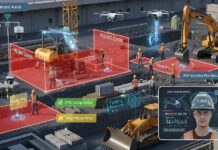
Integration of predictive analytics and machine learning into collaborative systems enables proactive safety intervention before incidents occur. Sensor data tracking worker movement, equipment proximity, and environmental conditions feeds machine learning algorithms that recognize patterns preceding accidents. Systems alert workers and supervisors when conditions approach dangerous configurations, enabling corrective action before incidents materialize. This predictive approach to construction safety represents fundamental shift from reactive incident response toward proactive hazard elimination, creating safer jobsites through systematic risk management rather than accident-based learning.
Productivity Enhancement and Schedule Compression
Economic benefits of human-machine collaboration construction emerge through multiple channels beyond simple labor cost reduction. Robotic systems operate continuously without fatigue-related performance degradation, maintaining consistent productivity throughout extended work periods. Human workers manage supervisory functions, adapt to changing conditions, and execute complex decision-making while mechanical partners maintain relentless task execution pace. This complementary capability set enables projects to complete specific operations substantially faster than purely human-dependent approaches, compressing overall construction schedules and enabling earlier project turnover.
Productivity improvements particularly benefit projects involving repetitive elements or large-scale operations where mechanical consistency delivers compound efficiency advantages. A parking structure project requiring hundreds of parking space line painting operations sees dramatic schedule compression when autonomous marking robots handle repetitive painting while humans verify quality and manage special situations. Similarly, large-scale floor polishing in warehouse construction accelerates substantially when collaborative polishing robots work alongside human supervisors ensuring specification compliance while reducing crew size requirements.
Research into human-machine collaboration construction productivity impacts indicates proactive interaction design between robots and workers can enhance overall productivity by up to 22 percent compared to equivalent human-only operations. These improvements emerge not from replacing workers but from optimizing work allocation between human and mechanical capabilities, enabling both to operate at peak efficiency within their respective competency domains. Construction companies capturing these productivity advantages gain substantial competitive benefits through improved project economics, expanded capacity to pursue larger projects, and enhanced client satisfaction through accelerated delivery timelines.
Challenges and Future Development Trajectories
Despite compelling advantages, mainstream adoption of human-machine collaboration construction encounters obstacles requiring thoughtful resolution. Capital investment requirements exceed equipment costs for smaller contractors, necessitating creative financing arrangements or equipment-as-service models that distribute ownership costs across multiple projects. Regulatory uncertainty regarding robot operation in construction environments creates liability concerns and compliance ambiguity that conservative contractors find problematic. Cultural resistance from workers or management skeptical of automation requires comprehensive change management and transparent communication demonstrating how collaboration benefits all stakeholders.
Future development trajectories for human-machine collaboration construction increasingly emphasize artificial intelligence advancing robot autonomy and decision-making capabilities. Machines learning from experience, adapting to novel situations, and communicating effectively with human partners enable deeper collaboration transcending current teleoperated or pre-programmed systems. Advanced augmented reality interfaces overlaying digital information onto worker field-of-view simultaneously inform decisions, enhance safety awareness, and enable seamless human-machine communication. Construction management software increasingly integrates robotic operations into overall project planning, enabling systematic optimization of human and machine resource deployment throughout project execution.
The evolution toward integrated human-machine construction teams represents inevitable industry progression driven by labor shortages, safety imperatives, and economic advantage. Organizations embracing collaborative robotics early establish competitive positions strengthening throughout their operational lifespans. Construction professionals recognizing this transformation and positioning themselves as collaborative robotics experts capture disproportionate market opportunities. The future of construction belongs to organizations understanding that human-machine collaboration construction represents not worker displacement but rather fundamental enhancement of human capability, creating safer, more efficient, and more humane construction environments for all participants.