

























Key Takeaways:
- Comprehensive durability testing exterior building components protocols are essential for predicting the long-term performance of building envelopes, protecting against environmental stressors like UV radiation, thermal cycling, and wind-driven rain.
- Physical testing methods, including accelerated aging and dynamic wind load analysis, provide the empirical data necessary to ensure material compatibility and structural integrity, far exceeding the capabilities of theoretical modeling alone.
- Investing in rigorous testing not only ensures occupant safety and building longevity but also offers significant financial benefits by reducing the risk of construction defects and increasing the market value of the property.
Durability Testing Methods for Exterior Building Components
The exterior envelope of a building is its first line of defense against the relentless forces of nature. From the scorching heat of the sun to the abrasive power of wind-driven rain and the cyclic stress of freeze-thaw cycles, building facades are constantly under assault. Ensuring that these systems remain functional and aesthetically pleasing over a lifespan of 30, 50, or even 100 years requires more than just good design; it requires empirical proof. This is where the sophisticated durability testing exterior building components undergo becomes indispensable. By subjecting materials and assemblies to rigorous laboratory simulations, engineers can predict performance with a level of confidence that traditional observation simply cannot provide.
The Imperative of Performance Validation
In the modern construction landscape, the complexity of materials ranging from high-performance glass and aluminum composites to advanced fiber-cement panels demands a standardized approach to verification. The goal of durability testing exterior building components is to identify potential failure points before they become costly liabilities. A failure in the building envelope can lead to water infiltration, which in turn causes structural rot, mold growth, and a significant degradation of indoor air quality. Thus, testing is not merely a bureaucratic checkbox but a critical component of quality assurance that protects both the developer’s investment and the safety of the occupants.
Accelerated Weathering and Aging Simulations
One of the most common methods used in the industry is accelerated weathering. Because we cannot wait decades to see how a new material will perform, laboratories use specialized chambers to compress time. These chambers expose samples to intense ultraviolet (UV) radiation, high humidity, and temperature fluctuations in rapid succession. This process simulates years of environmental exposure in a matter of weeks. By monitoring changes in color, gloss, and structural bond strength, researchers can determine the expected service life of the durability testing exterior building components and identify any chemical instabilities that might lead to premature degradation.
The Role of UV Exposure and Thermal Cycling
UV radiation is particularly damaging to polymers and coatings, often leading to “chalking” or brittleness. In a thermal cycling test, components are moved between extreme heat and sub-zero temperatures. This stresses the interfaces between different materials, such as the sealant between a window frame and the masonry. If the materials have different coefficients of thermal expansion, the cycling will reveal if the joints will stay watertight or if they will pull apart over time. This level of scrutiny is a hallmark of high-standard construction standards and ensures that the durability testing exterior building components provides actionable data for design adjustments.
Testing for Structural Integrity and Impact Resistance
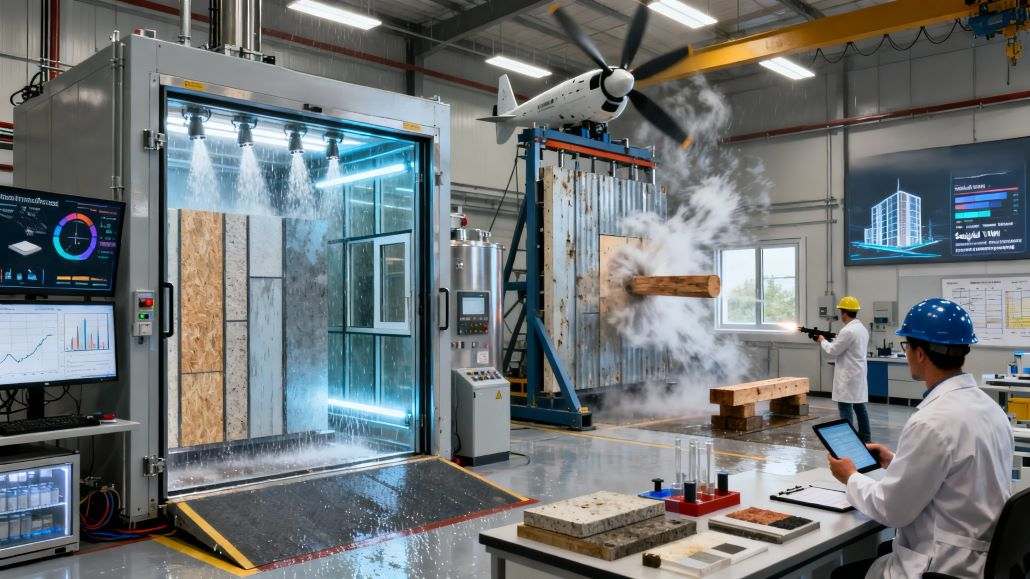
Beyond the slow wear of the elements, exterior components must also withstand sudden, violent forces. In regions prone to hurricanes or severe thunderstorms, impact resistance is a primary concern. Testing involves firing standardized projectiles such as 2×4 timber studs or steel balls at windows, doors, and cladding panels at high velocities. This simulates wind-borne debris. If a component can maintain its integrity during such an event, it prevents the internal pressurization of the building, which is often what leads to roof failure and total structural loss during a storm.
Wind-Driven Rain and Air Infiltration Analysis
Water is arguably the greatest enemy of any building. To test for water tightness, entire wall assemblies are mounted in large pressure chambers. High-pressure water jets are directed at the surface while a vacuum is applied to the interior side, creating a pressure differential that mimics a severe storm. This durability testing exterior building components procedure reveals even the smallest leaks in gaskets or drainage paths (weep holes). Simultaneously, air infiltration tests measure how much air leaks through the assembly, which is a critical factor in determining the energy efficiency and thermal comfort of the building.
Dynamic Wind Load Testing
Static pressure tests provide a baseline, but real wind is dynamic and gusty. Dynamic wind load testing uses large aircraft-style propellers to create turbulent airflows against the facade. This test is crucial for skyscrapers, where wind speeds at upper floors can be significantly higher than at ground level. It ensures that cladding panels won’t vibrate loose or “oil-can” a term for the visible buckling of metal panels under pressure. This rigorous durability testing exterior building components protocols ensure that the building remains a safe and quiet haven for its inhabitants, regardless of the weather outside.
Corrosion and Chemical Resistance in Coastal Environments
For buildings located near the ocean, salt spray is a major factor in material degradation. The chloride ions in sea air can rapidly corrode metal components and break down protective coatings. Durability testing exterior building components for these environments involves salt fog chambers, where samples are continuously misted with a saline solution. This test is essential for selecting the right grade of stainless steel or the correct thickness of an anodized finish. Furthermore, in urban areas, testing must also account for pollutants like sulfur dioxide, which can cause “acid rain” damage to stone and concrete surfaces.
The Importance of Material Compatibility
Modern facades are rarely made of a single material; they are systems of glass, metal, stone, and various sealants and adhesives. A critical part of durability testing exterior building components is ensuring that these materials don’t react negatively with one another. For example, certain sealants can leach oils that stain natural stone, or two dissimilar metals in contact can cause galvanic corrosion. Compatibility testing ensures that the “handshake” between different components is secure and long-lasting, preventing “silent” failures that occur hidden from view within the wall assembly.
The Evolution of Testing Standards and Digital Twins
As technology advances, so too do the methods for validating building performance. We are seeing a move toward “digital twins,” where a physical component is tested in a lab, and the results are used to calibrate a highly accurate computer model. This model can then simulate how the entire building will behave under thousands of different environmental scenarios. However, while digital modeling is powerful, the industry still relies on physical durability testing exterior building components as the “gold standard” for certification. Organizations like ASTM International and the American Architectural Manufacturers Association (AAMA) provide the rigorous frameworks that keep these tests consistent and reliable across the globe.
The Financial and Legal Benefits of Rigorous Testing
From a business perspective, investing in durability testing exterior building components is a form of insurance. It significantly reduces the risk of future litigation due to construction defects. For manufacturers, a certified test report is a powerful marketing tool that proves the superiority of their product. For building owners, it provides peace of mind that their asset will not require premature and expensive facade renovations. In many jurisdictions, certain tests are also a legal requirement for obtaining a building permit, further underscoring their importance in the modern construction lifecycle.
The Crux of Quality Assurance
In conclusion, the science of durability testing exterior building components is what allows us to build with confidence in an increasingly unpredictable climate. It bridges the gap between architectural vision and long-term reality. By understanding the stressors of the environment and subjecting our materials to the most extreme conditions in a controlled setting, we ensure that our built environment is not only beautiful but truly resilient. The core of this effort the durability testing exterior building components remains the essential foundation of high-quality, professional construction today.
